Who can change Scotland’s tribunal deadlines?
A new order shows how a power granted at Westminster can be exercised by Scottish Ministers, with approval from both governments and Holyrood.
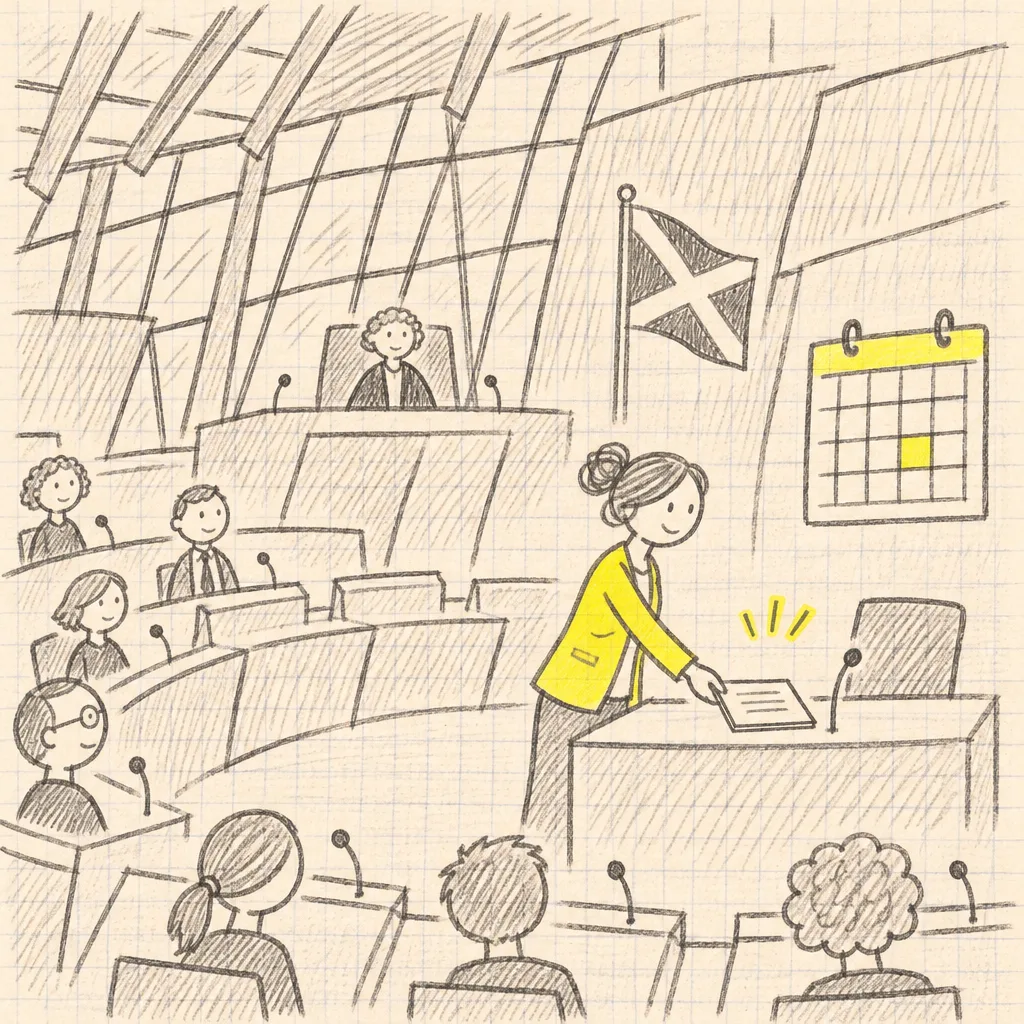
Scottish Ministers have changed a rule on employment contract claims without Parliament passing a new Act for that change. The order signed by Tom Arthur on 3 November 2026 will give some employees longer to bring a claim to a Scottish employment tribunal, a body that decides workplace disputes.
To understand how that is possible, start with an Act of Parliament: a law passed by Parliament that can give ministers authority to make more detailed law. The UK Parliament passed the Employment Tribunals Act 1996. It gives ministers powers relating to which contract claims an employment tribunal can hear and how those claims are handled.
A contract is an agreement setting out obligations between an employer and employee, such as the pay due for a period of notice. If an employer does not pay what the contract requires when a job ends, the employee may be able to ask a tribunal to decide the dispute. That is a contract claim. It is different from asking whether a dismissal was unfair: different claims have different legal rules.
The 1996 Act did not write every future tribunal rule into its own pages. It allowed ministers to make certain rules through an order. An order is a form of secondary legislation: law made using a power granted by an Act. The Scottish order is a Scottish statutory instrument, the formal document used to make this kind of law.
Here is the chain of authority. The power under section 3 of the 1996 Act moved from the Lord Advocate, a Scottish law officer, to a UK Secretary of State in 1999. A further transfer order that year passed the relevant function to Scottish Ministers. So the authority traces back to an Act of the UK Parliament and the transfer of the function; Scottish Ministers did not create it for themselves.
The transfer came with a condition. The 1999 transfer order requires the Secretary of State’s agreement to this use of the power. The new Scottish order says that agreement was obtained. It does not name the minister who gave it.
Agreement from the UK Government was not the only check. The instrument followed the affirmative procedure, which means a draft had to be approved by the Scottish Parliament before ministers could make it. Think of it as permission for this particular order, not a new Act granting the original power.
The Scottish Parliament’s Economy, Tourism and Energy Committee questioned Arthur about the draft on 22 September 2026 and recommended approval. The Parliament’s official report records that members approved it on 28 October 2026 alongside other business, without a separate recorded vote on the order. Arthur signed it for Scottish Ministers on 3 November 2026; the order comes into force on 9 November 2026.
That sequence matters. The committee could question the minister and recommend a decision; the Parliament had to approve the draft; the Secretary of State had to agree; and Scottish Ministers made the order. None of those steps is the same as passing a fresh Act. They also do not mean ministers can change any deadline they choose: the order must stay within the powers Parliament has granted.
The order changes an existing Scottish order made in 1994. In its rules on when an employee’s contract claim must be brought, the new instrument replaces three months with six months. The affected claims include a sum owed under a contract when employment ends, such as unpaid contractual notice pay. The change is not a general extension for every kind of tribunal claim.
The new order also contains a transitional provision: a rule deciding which cases move from the old arrangements to the new ones. Its dividing line is 9 November 2026, according to the order. The relevant date is normally the effective termination date, meaning the date employment legally ends under the definition in the order. Where there is no such date, the order uses the last day worked.
Imagine two employees with otherwise qualifying claims for unpaid notice pay. One employee’s job ends on 8 November 2026 and the other’s ends on 9 November 2026. Under the order’s boundary, the first ordinarily remains under the three-month rule and the second comes under the six-month rule. Submitting both claims after the new order starts would not, by itself, put both employees under the longer rule.
These are ordinary limits, not complete deadline calculations. The existing order allows a tribunal to accept a claim later if it was not reasonably practicable to present it in time and the claim is then presented within a further period the tribunal considers reasonable. Early conciliation, an attempt to resolve a dispute with help from the public body Acas before a tribunal claim, can also affect the calculation. Neither outcome should be assumed.
The Scottish Government says the longer period should give employees more time to seek advice and resolve disputes. That is a credible benefit, but the order’s explanatory note does not estimate how many people will be helped. More time can leave employers facing a possible claim for longer; if more claims are brought, tribunal users and public funders could face extra costs or waiting. The note gives no estimate of those effects either.
The boundary is a policy choice, not a finding that the earlier employee has a weaker case. A start date gives people a rule for deciding which law applies, but it also leaves some workers with less time because their employment ended just before the line. Ministers and Parliament could have chosen a different transition within the available powers; the order does not explain why this particular boundary is fair to those left out.
There is also a separate geographical choice. The Scottish order does not change the corresponding rules for England and Wales. A separate UK order gives qualifying contract claims there a longer ordinary limit where the relevant termination date falls on or after 1 October 2026. Arthur told the Scottish Parliament’s committee that Scottish Ministers had asked the UK Government to consider delaying the England and Wales change so the dates could align; he pointed to constraints on Scottish parliamentary time, including the election and summer recess.

Keep going
 Law
When does a Scottish Act actually take effect?
The building safety levy shows why an Act can become law months before ministers bring particular parts into force.
 Law
Who Decides What Happens in a Criminal Trial
A Palestine Action case offers a lesson in charging, evidence, reporting restrictions and the difference between a document and a claim about it.
 Law
Why a Scottish law can wait years to take effect
Scottish Ministers have set a start date for more trust rules, but have not said when rules for private purpose trusts will begin.