What a Liverpool Street safety digest can tell us
The rail accident investigator has chosen a shorter route after a train struck a buffer stop, but has not explained why.
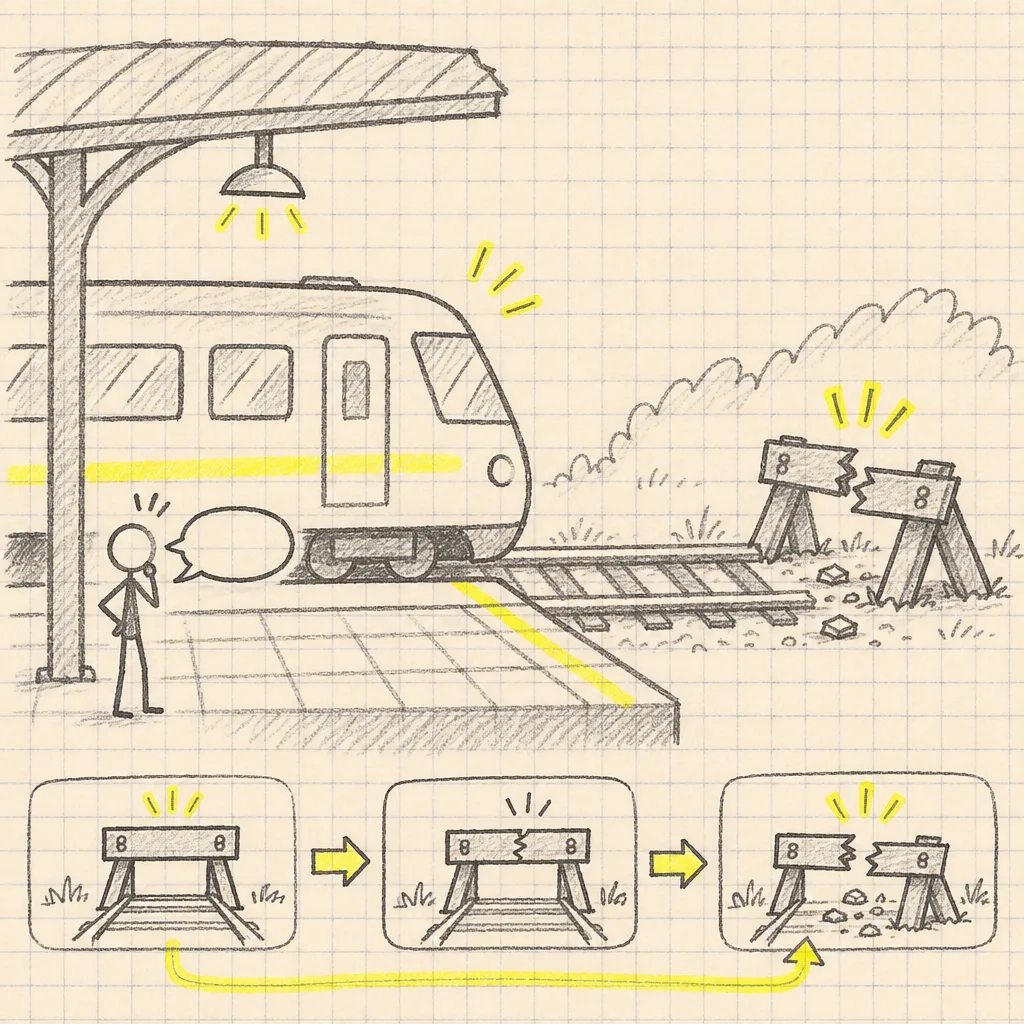
A train hit a buffer stop at London Liverpool Street at about 00:58 on 15 October 2026, according to the Rail Accident Investigation Branch. A buffer stop is the structure at the end of a track intended to stop a train going farther. The train was out of service, meaning it was not carrying passengers as a scheduled service.
The branch, an independent railway safety investigator, says the train was travelling at an estimated 7 mph when it struck the stop on platform 1. Its notice says the first three vehicles came off the rails, the train and stop were damaged, and the driver went to hospital but suffered no physical injuries.
Those details tell us about the collision and the immediate physical outcome reported for the driver. They do not tell us why the train failed to stop, whether anyone else was aboard, or whether the driver experienced other effects. The speed is an estimate, not an explanation. The notice does not show the recording or calculation behind it.
The branch has chosen to publish a safety digest after a preliminary examination: an initial gathering of evidence to decide what further work is warranted. A safety digest is a shorter publication that shares safety lessons without a full investigation. For example, it might remind railway companies to follow an existing rule if the evidence shows that rule matters to the event.
Who decides? The branch’s guidance says its Chief Inspector decides whether to conduct a full investigation after a preliminary examination. The branch announced the digest for Liverpool Street but did not name the individual who made that choice.
The choice matters. The branch says it may use a digest when a previous investigation has already identified the lesson, or when the lesson concerns compliance with existing rules. A full investigation can examine evidence such as recordings, witnesses and tests in greater depth. Its report can make formal safety recommendations; a digest contains learning but not those recommendations. Neither route is meant to assign blame.
The notice does not say which reason applies here, what evidence has been gathered or what further inquiries will be made. That leaves readers unable to judge whether the shorter route is adequate. Railway companies and staff may benefit from a useful lesson; passengers may benefit if it leads to action. For now, neither the lesson nor the action is known.

Keep going
 Media literacy
What a Companies House entry can tell you
The agency’s verification target counts more than completed checks, while an entry on its public register is not a guarantee of accuracy.
 Media literacy
What the Edan Alexander citizenship claims prove
The White House called the freed hostage an American citizen, while The Grayzone reported the opposite. Neither account gives readers the underlying record.
 Media literacy
How to read a business payment request
A government warning about unsolicited invoices raises three separate questions: who sent the request, what it offers and whether payment is required.