The sentence hiding a Gibraltar extension
A one-word legal change keeps UK-Gibraltar financial-services access alive until 31 December 2027.
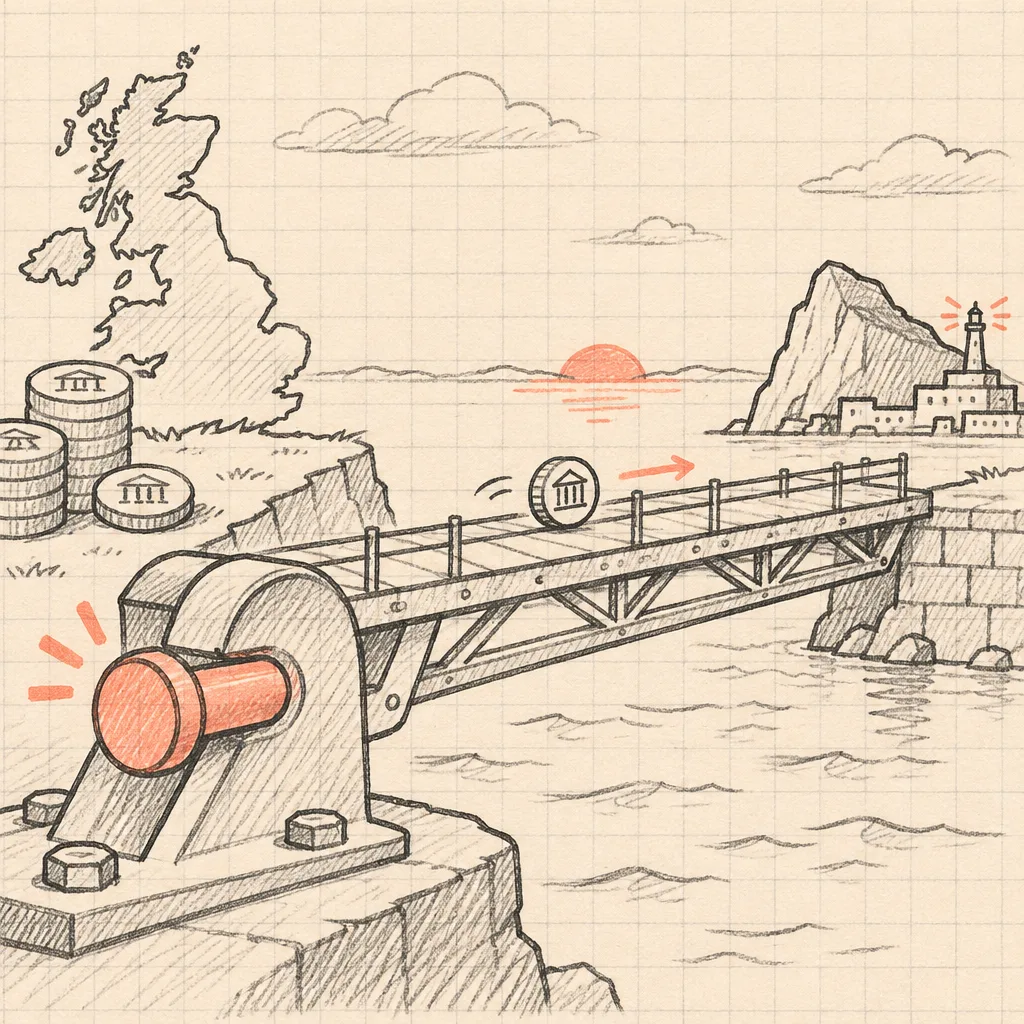
The Financial Services (Gibraltar) (Amendment) (EU Exit) Regulations 2026 were made by HM Treasury on 2 November 2026, laid before Parliament on 3 November 2026, and come into force on 16 December 2026, according to S.I. 2026/1154.
The whole legal move is one sentence: in regulation 12 of the 2019 Gibraltar financial-services regulations, for “2026” substitute “2027”. That is the sentence doing the hiding. It looks like a small edit. It is really a switch that keeps Parts 2 and 3 of the 2019 regulations alive for another year.
Here is how it works. A statutory instrument is a law made by ministers using a power Parliament has already given them. In 2019, Parliament approved regulations dealing with UK-Gibraltar financial-services access after EU exit. Regulation 12 said Parts 2 and 3 would expire at the end of 2020, but it also gave the Treasury power to extend them by 12 months at a time. The 2026 instrument uses that power again.
To understand who is covered, you cannot stop at the 2026 instrument. You must follow the cross-reference back to S.I. 2019/589. Parts 2 and 3 are the working machinery. They preserve a route for specified Gibraltar-based financial-services firms to provide services in the UK, and they support access for similar UK-based firms into Gibraltar. The 2026 note says that; it does not name the firms.
The official story is that this is a technical 12-month extension. The Treasury says no full impact assessment has been produced because no, or no significant, impact is expected on the private, voluntary or public sectors. The note says a de minimis impact assessment exists. De minimis means too small to need the full process.
But the older papers make the story less tiny. HM Treasury’s 2025 de minimis assessment reportedly used FCA data to describe Gibraltar-based firms operating in the UK. It also reportedly used Government of Gibraltar data to describe the share of UK motor insurance policies provided by Gibraltar-based insurers. Those figures are not in the 2026 instrument supplied here.
A small glossary helps. A sunset clause is an expiry date written into law. Negative procedure means an instrument becomes law unless either House of Parliament annuls it. Reciprocal means each side gets access to the other’s market, though it does not prove the access is equal in practice. The Gibraltar Access Regime is the planned longer-term system created by the Financial Services Act 2021.
Who decides? HM Treasury decides to make the extension, using the 2019 power. Parliament can object under the negative procedure, but it is not being asked to pass a new Act. Who benefits? Eligible firms and existing customers avoid a cliff edge. Who pays? Regulators, customers, competitors and Parliament carry the cost of not being shown the full map.

Keep going
 Media literacy
What a Companies House entry can tell you
The agency’s verification target counts more than completed checks, while an entry on its public register is not a guarantee of accuracy.
 Media literacy
What the Edan Alexander citizenship claims prove
The White House called the freed hostage an American citizen, while The Grayzone reported the opposite. Neither account gives readers the underlying record.
 Media literacy
How to read a business payment request
A government warning about unsolicited invoices raises three separate questions: who sent the request, what it offers and whether payment is required.